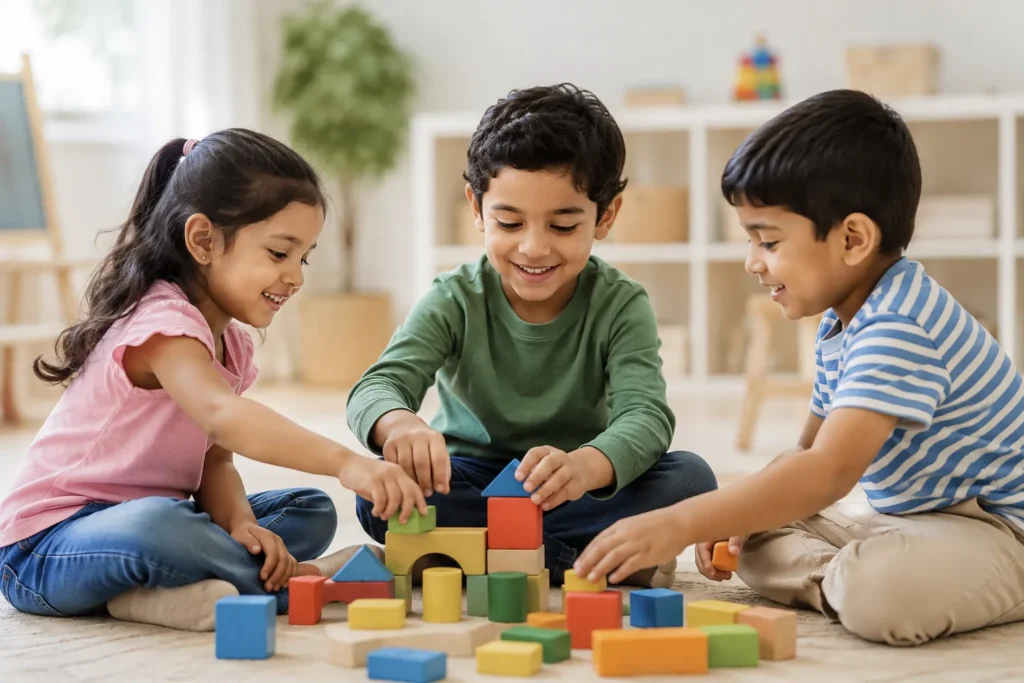
Watching a child learn to smile, sit, speak, play, and become more independent is an important part of parenting. These abilities usually appear gradually as the child grows.
Developmental milestones by age are skills or behaviours that most children are expected to develop within certain age ranges. They can involve movement, communication, thinking, social interaction, play, and everyday activities.
Milestones are useful guides rather than strict deadlines. Children do not all develop at exactly the same pace. One child may start walking earlier while another develops spoken language sooner.
Parents should pay attention to the overall pattern of development rather than comparing one child directly with another.
This guide explains common child development milestones from birth to 5 years and highlights signs that may be worth discussing with a qualified child development professional.
What Are Developmental Milestones by age in Children?
Developmental milestones are observable skills and behaviours that children typically acquire as they grow.
Healthcare and child development professionals use milestones to understand how a child is progressing across different developmental areas. The Centers for Disease Control and Prevention, commonly known as the CDC, provides milestone guidance for children from early infancy through the preschool years.
Development is commonly observed across four broad areas:
- Movement and physical development: Sitting, crawling, walking, running, using the hands, and coordinating body movements.
- Language and communication: Making sounds, understanding language, using words, and communicating needs.
- Cognitive development: Learning, remembering, solving simple problems, and understanding how things work.
- Social and emotional development: Connecting with caregivers, showing emotions, playing with others, and developing independence.
A child may progress quickly in one area and need more time in another.
The pattern matters more than a single milestone.
Parents can use baby milestones and toddler milestones to observe progress over time. A developmental screening or assessment may be useful when several expected skills are delayed, a child loses previously acquired abilities, or parents have ongoing concerns.
What Developmental Milestones Are Common From Birth to 6 Months?
During the first 6 months, babies begin developing stronger social responses, body control, visual attention, and early communication skills.
A newborn depends almost completely on caregivers. Over the following months, the baby gradually becomes more responsive to people and surroundings.
Common milestones during this period may include:
- Looking at faces
- Reacting to familiar voices
- Smiling in response to social interaction
- Making sounds other than crying
- Following people or objects with the eyes
- Holding the head with increasing control
- Bringing hands toward the mouth
- Reaching toward interesting objects
- Showing enjoyment during interaction
By around 6 months, many babies become more interested in people and objects around them. They may laugh, make repeated sounds, reach for toys, and use their hands more purposefully.
Tummy time and supervised floor play can support early movement development. Talking, singing, smiling, and responding to a baby’s sounds can support communication and social interaction.
Parents should discuss concerns with a healthcare professional if their baby rarely responds to sounds, shows very limited social interaction, has difficulty controlling the head as expected, or loses a skill that was previously present.
What Developmental Milestones by Age are Common From 6 to 12 Months?
Between 6 and 12 months, babies often become more mobile, interactive, and intentional in how they communicate.
This stage can bring noticeable changes in movement. Babies may begin sitting with greater stability and moving around their environment in different ways.
Common baby milestones during this age range may include:
- Sitting with increasing independence
- Moving objects between the hands
- Reaching accurately for toys
- Making repeated sounds such as babbling
- Responding to familiar voices
- Showing interest in interactive games
- Looking for an object that has been partially hidden
- Using gestures to communicate
- Showing stronger reactions to familiar and unfamiliar people
Some babies crawl before walking. Others may move by rolling, shuffling, or using another method.
Crawling is not a milestone that every child follows in exactly the same way.
Communication also becomes more purposeful during this period. Babies may combine sounds, facial expressions, eye gaze, and gestures to get attention.
Parents can support development through safe floor play, face-to-face interaction, picture books, songs, and simple games.
A professional opinion may be helpful when a baby shows persistent difficulties with movement, communication, social interaction, or response to sound.
What Developmental Milestones Are Common From 1 to 2 Years?
Between 1 and 2 years, children usually make major gains in walking, communication, play, and independence.
This period often brings rapid changes. A young toddler may move from taking early steps to walking more confidently within a relatively short time.
Common toddler milestones may include:
- Walking independently
- Picking up small objects with better control
- Using gestures to communicate needs
- Understanding simple words or instructions
- Beginning to use meaningful words
- Copying simple actions
- Showing interest in familiar people
- Exploring toys in more purposeful ways
- Drinking from a cup with increasing independence
Language development can vary considerably at this age.
Communication should not be judged only by the number of spoken words. Professionals may also consider how a child understands language, uses gestures, shares attention, responds to people, and attempts to communicate.
Parents can encourage development by naming everyday objects, reading simple books, allowing safe physical play, and giving the child opportunities to communicate during normal routines.
Repeated concerns about communication, movement, social interaction, or loss of previously learned abilities should be discussed with a qualified professional.
What Developmental Milestones Are Common From 2 to 3 Years?
Between 2 and 3 years, children often become more active, verbal, imaginative, and independent.
This is an important period for toddler milestones because language, play, motor skills, and social awareness often develop rapidly.
Common skills may include:
- Running with better balance
- Climbing onto suitable furniture or play equipment
- Using a spoon with increasing control
- Combining words into short phrases
- Following simple directions
- Naming familiar objects or people
- Engaging in early pretend play
- Showing a wider range of emotions
- Becoming more interested in other children
- Attempting simple self-care activities
Pretend play becomes especially useful to observe during this stage.
A child may pretend to feed a doll, talk on a toy phone, cook imaginary food, or copy everyday household activities. These behaviours can reflect developing imagination, memory, communication, and social understanding.
Parents can support development through conversation, pretend play, outdoor movement, drawing, simple puzzles, and age-appropriate household routines.
If a child has persistent difficulty understanding simple language, communicating needs, interacting socially, or developing expected movement skills, a developmental evaluation may help identify the type of support needed.
What Developmental Milestones Are Common From 3 to 4 Years?
Between 3 and 4 years, children usually develop stronger communication, imagination, coordination, and social participation.
Many children at this age become more interested in conversations and cooperative activities.
Common child development milestones may include:
- Speaking in longer phrases or sentences
- Asking for information and expressing ideas
- Understanding simple instructions
- Participating in imaginative play
- Playing with other children more actively
- Running and climbing with improved coordination
- Drawing simple shapes or marks
- Using everyday objects with greater independence
- Expressing preferences clearly
- Participating in simple routines
Children may also become more independent with eating, dressing, toileting, and other daily activities.
Preschool environments can make developmental differences easier to notice. Teachers may observe difficulties with communication, attention, play, coordination, behaviour, or following classroom routines.
One isolated difficulty does not automatically indicate a developmental condition.
A repeated pattern across several settings may deserve closer attention.
Parents and teachers can share observations to understand whether a difficulty happens occasionally or consistently.
What Developmental Milestones Are Common From 4 to 5 Years?
Between 4 and 5 years, children usually develop more advanced communication, social participation, movement, and independence.
These skills help prepare children for the routines and expectations of school.
Common milestones may include:
- Speaking clearly enough for familiar communication
- Telling simple stories or describing events
- Following multi-step everyday directions
- Participating in imaginative and cooperative play
- Taking turns with support
- Using pencils, crayons, and simple tools with better control
- Dressing with greater independence
- Running, jumping, and climbing with improved coordination
- Recognising some basic concepts such as colours, shapes, or numbers
- Managing familiar routines with less adult assistance
School readiness involves more than knowing letters or numbers.
Communication matters.
Emotional regulation matters.
Motor coordination matters.
The ability to participate in routines also matters.
A child does not need to perform every skill perfectly before starting school. The goal is to observe whether development is moving forward across several areas.
Parents who notice persistent difficulties with communication, movement, attention, social participation, or everyday independence can discuss these concerns before school demands increase.
When Should Parents Be Concerned About Developmental Milestones?
Parents should consider seeking professional guidance when developmental concerns persist, affect everyday functioning, involve several areas of development, or include loss of previously acquired skills.
Developmental delay is estimated to affect around 1–3% of children under the age of 5 worldwide, highlighting the importance of monitoring developmental milestones during early childhood.
Missing one milestone does not automatically mean that a child has a developmental disorder.
Children develop at different rates.
Certain patterns deserve closer attention.
These may include:
- Loss of a skill the child previously used
- Persistent difficulty communicating needs
- Limited response to sounds or social interaction
- Ongoing difficulty with movement or coordination
- Significant challenges with everyday activities
- Development that appears noticeably different across several areas
- Concerns repeatedly noticed by parents, caregivers, or teachers
Developmental concerns can have different causes.
Hearing difficulties may affect communication.
Motor difficulties may affect movement and independence.
Developmental conditions may influence several areas at the same time.
Early identification helps professionals understand the child’s strengths and areas that may need support.
Parents do not need to wait for a problem to become severe before discussing a concern.
How Is a Child’s Development Assessed?
A developmental assessment looks at a child’s abilities across relevant areas such as communication, movement, learning, behaviour, social interaction, and daily living skills.
The assessment process depends on the child’s age and the concerns reported by parents or caregivers.
It may include:
- A detailed developmental history
- Discussion with parents or caregivers
- Observation of the child
- Age-appropriate developmental screening or assessment tools
- Review of communication, motor, behavioural, or sensory concerns
- Recommendations based on the findings
Some children may need input from more than one professional.
A multidisciplinary team can include professionals from developmental paediatrics, speech and language therapy, occupational therapy, physiotherapy, psychology, or behavioural services.
The goal of assessment is not simply to compare a child with a checklist.
The goal is to understand how the child functions in everyday life and identify support that may be appropriate.
Parents in Kerala who have ongoing concerns about their child’s development can consider a child development assessment with a qualified multidisciplinary team.
How Can Parents Support Healthy Child Development at Home?
Parents can support development through simple, repeated interactions during everyday routines.
Expensive toys or highly structured activities are not required for most learning experiences.
Helpful activities include:
- Talking about what is happening during meals, bathing, dressing, and travel
- Reading age-appropriate books together
- Singing songs and repeating simple rhymes
- Allowing safe floor and outdoor play
- Giving children time to attempt tasks independently
- Encouraging drawing, building, sorting, and pretend play
- Responding when the child communicates through sounds, gestures, words, or expressions
- Maintaining predictable sleep and daily routines
Play is an important part of early learning.
A child can practise language while playing with toy animals.
Fine motor skills can develop through drawing or building blocks.
Social skills can develop through shared games.
Movement skills can develop through climbing, running, and supervised outdoor activity.
Daily interaction matters more than trying to turn every activity into a formal lesson.
Developmental Milestones Are Guides, Not Deadlines
Developmental milestones by age help parents understand how skills commonly emerge from birth to 5 years.
They are reference points rather than strict deadlines.
A child’s development should be viewed as a pattern across communication, movement, thinking, social interaction, play, and everyday independence.
Parents often know their child’s everyday behaviour better than anyone else. Repeated concerns deserve attention even when a child appears to be progressing well in another area.
Parents who have concerns about their child’s communication, movement, behaviour, sensory responses, learning, or overall development can consider a developmental assessment for children with a child development centre to better understand their child’s individual needs.
Frequently Asked Questions
The main developmental milestones involve movement, communication, thinking, social interaction, emotional development, play, and everyday independence. The expected skills change as a child grows from infancy into the preschool years.
Yes. Children can reach individual milestones at different times. Development should be viewed as an overall pattern rather than judged by one skill alone.
Observe the child’s progress and discuss persistent concerns with a pediatrician or qualified child development professional. An assessment may be recommended when concerns affect several developmental areas or everyday functioning.
Children with developmental difficulties may benefit from support that matches their individual needs. The type of support depends on the child’s developmental profile and the reason for the difficulty.
Assessment may involve a pediatrician or developmental specialist. Depending on the child’s needs, speech and language therapists, occupational therapists, physiotherapists, psychologists, and other qualified professionals may also contribute.
Read more

How to Teach an Autistic Child at Home: A Practical Guide for Parents
UDID Card for Children with Autism in Kerala: Eligibility & How to Apply